Mobile Hydrogen Refuelling with HyAero Dynamics
How HyAero Dynamics and Swagelok Helsinki developed a mobile refuelling panel to bring hydrogen to airport ground support equipment.
How can hydrogen-powered equipment be refuelled at remote sites without a permanent dispenser?
Hydrogen-powered airport equipment needs to be refuelled where it works. For SIA HyAero Dynamics, that raised a practical engineering question: how could hydrogen be supplied at an airport or another remote site without installing a permanent dispenser?
Working with Swagelok Helsinki, the Latvian company developed a manually operated, mobile hydrogen refuelling panel. The assembly has since been used to refuel fuel-cell baggage tractors at Riga International Airport, providing a working platform for testing the concept and identifying what to develop next.
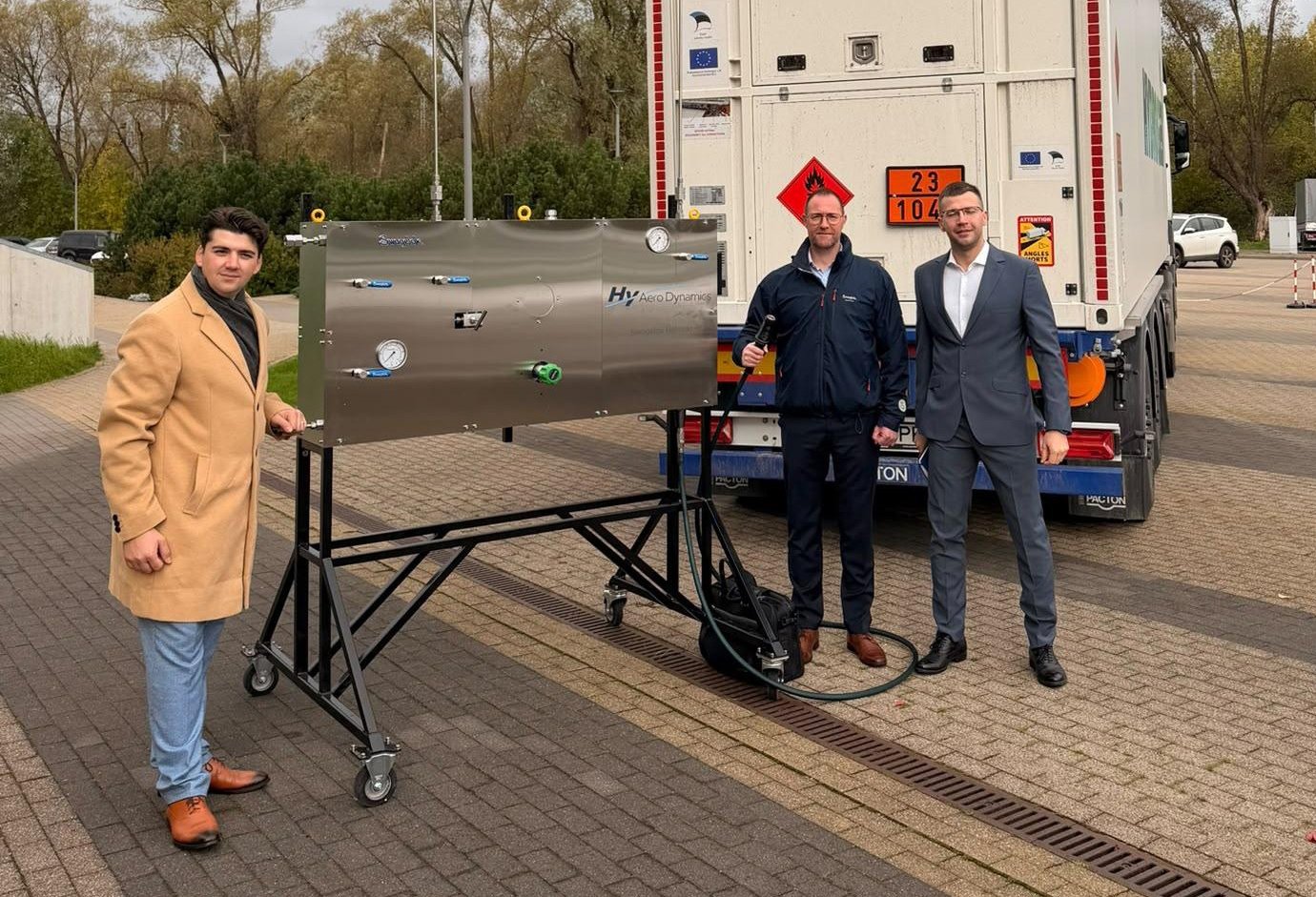
Pauls Plāters (left) from HyAero Dynamics, together with Hans-Henrik Hyöppönen and Matiss Vaivods from Swagelok Helsinki, presents the mobile hydrogen refuelling panel at Riga International Airport.
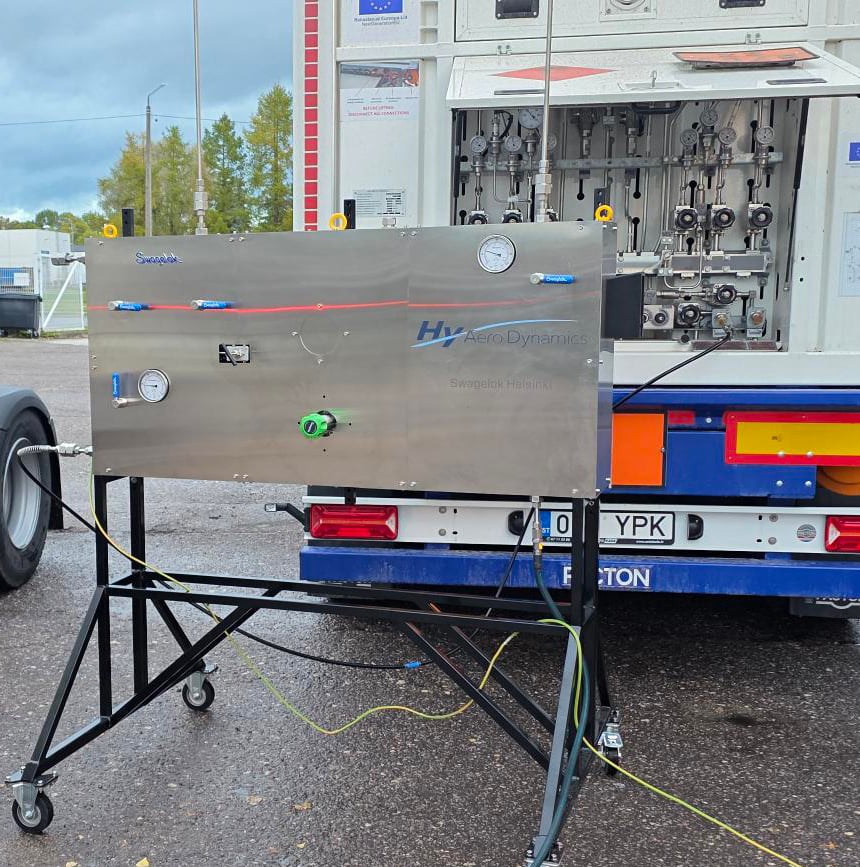
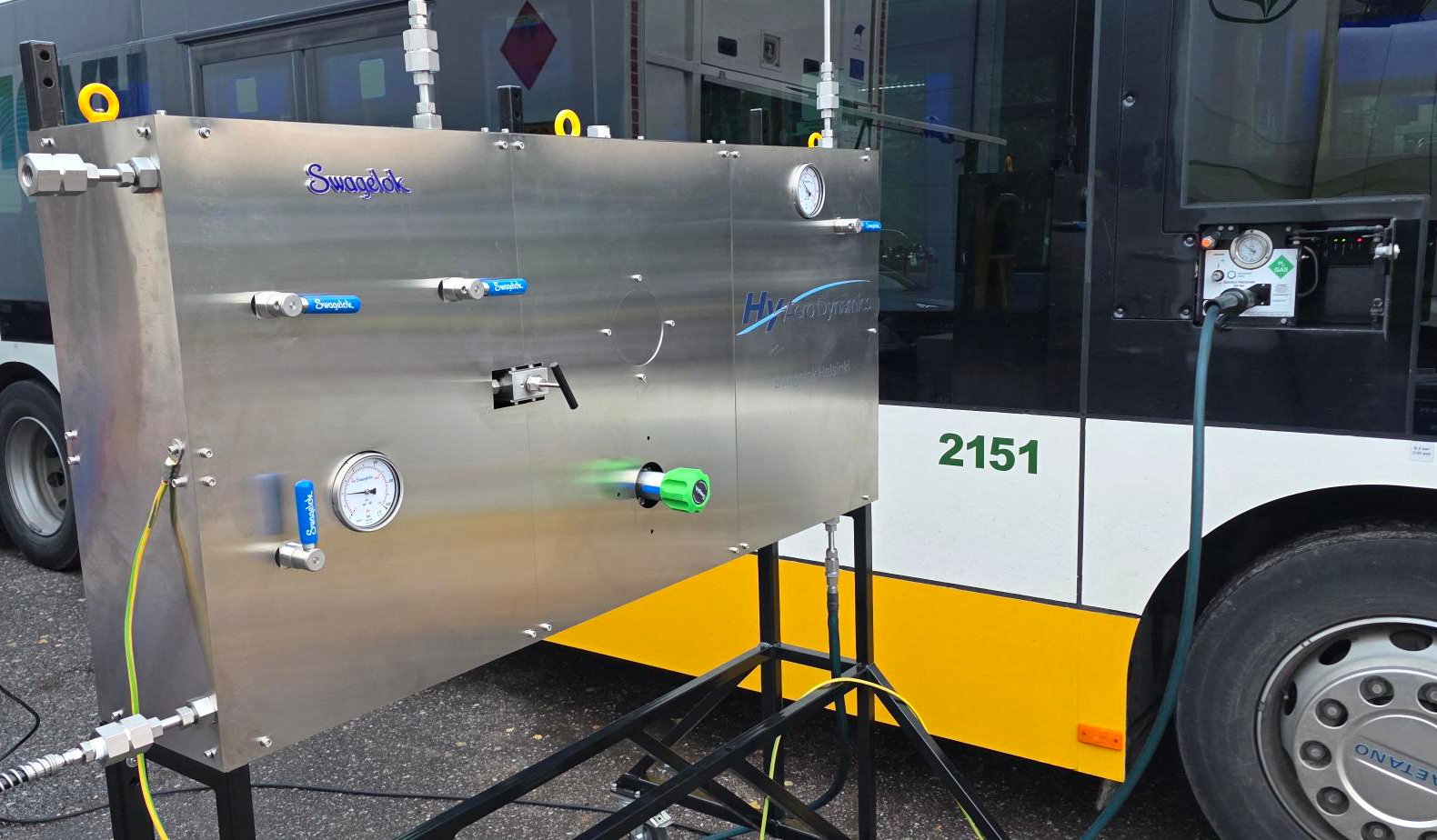
The mobile refuelling panel connected to a hydrogen cylinder truck.
Supporting Airport Ground Operations with Mobile Hydrogen Refuelling
HyAero Dynamics grew out of the Latvian Hydrogen Association. Pauls Plāters, a mechanical engineer working as a project manager and field engineer with both organisations, brought experience from hydrogen refuelling station operations to the project.
The need emerged through BSR HyAirport, a project bringing together 16 partners to explore hydrogen use in airport operations. For baggage tractors and other ground support equipment, access to fuel was a practical constraint. Travelling to an off-site refuelling station would add time and complicate daily operations.
The team wanted to bring the refuelling equipment to the vehicles. Their concept was a mechanical panel that a trained operator could use at locations without the infrastructure needed for a conventional automated dispenser.
In November 2025, Pauls Plāters approached Matiss Vaivods, Field Engineer and country sales representative at Swagelok Helsinki with initial sketches. The requirements went beyond a single vehicle application: the team also wanted to accommodate cylinder-bundle filling and different hydrogen supply arrangements.
Developing the panel layout together with Swagelok Helsinki
The working relationship predated the panel. Pauls had already contacted Matiss for components and technical support while working at a hydrogen refuelling station. Swagelok Helsinki had also provided practical training in tube fitting installation and tube bending, with Sami Juntunen, Technical Lead of Swagelok Helsinki.
That experience gave the teams a starting point for discussing the new assembly. During development, Pauls and Matiss reviewed component choices, connection arrangements, flow requirements and the practical sequence of operation.
The panel is designed for a maximum inlet pressure of 550 barg and incorporates Swagelok FK fittings and half-inch tubing. The initial flow target was 60 g/s; the resulting design was developed for a hydrogen flow capacity of up to 90 g/s, equivalent to 5.4 kg/min at that flow rate. Actual refuelling performance depends on the supply conditions, the receiving system and the operating procedure.
Plāters describes 90 g/s as the upper flow target for this concept without additional cooling, with temperature rise during refuelling a consideration for higher flow rates.
The physical format also changed. The original idea was a smaller panel mounted in a fixed location. As the intended applications developed, mobility became more useful. HyAero Dynamics prepared sketches for a wheeled stand, which Swagelok Helsinki then built as part of the assembly.
The panel can be moved on the stand, transported between sites or removed for fixed installation. During its first hydrogen refuelling deployment in Tartu, it travelled inside a hydrogen bus and was wheeled out for use.
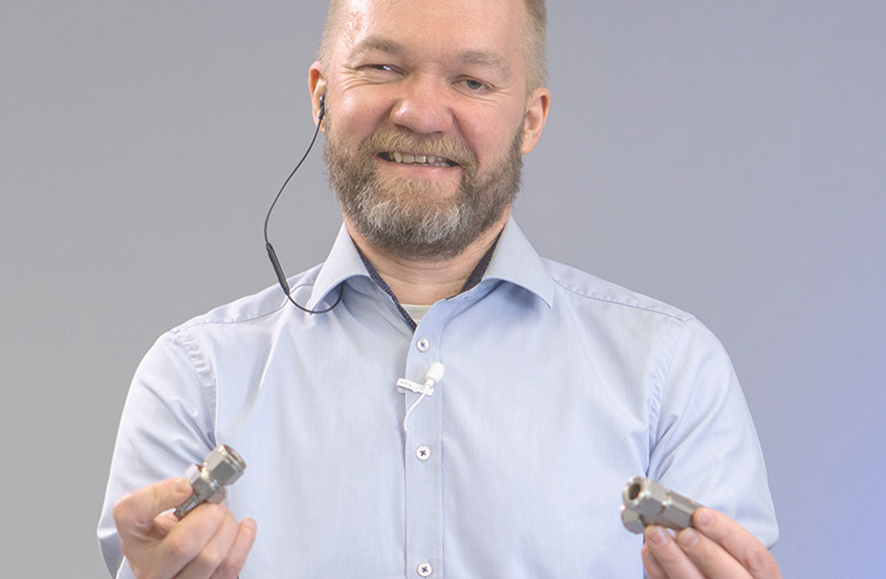
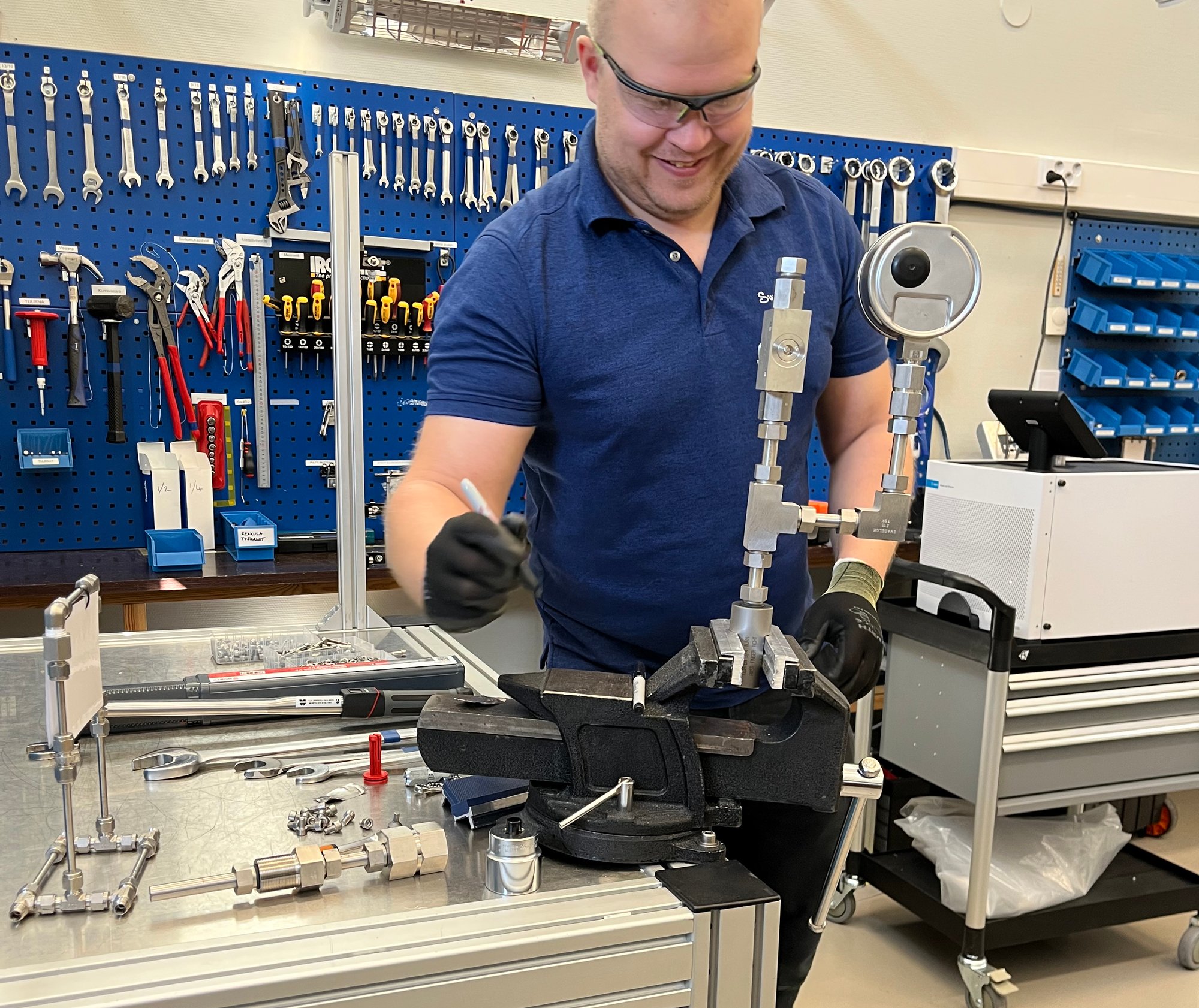
Tuukka Naumanen assembling the HyAero Dynamics panel at Swagelok Helsinki’s production facility.
Hydrogen Refuelling Panel: Manual Controls and Testing
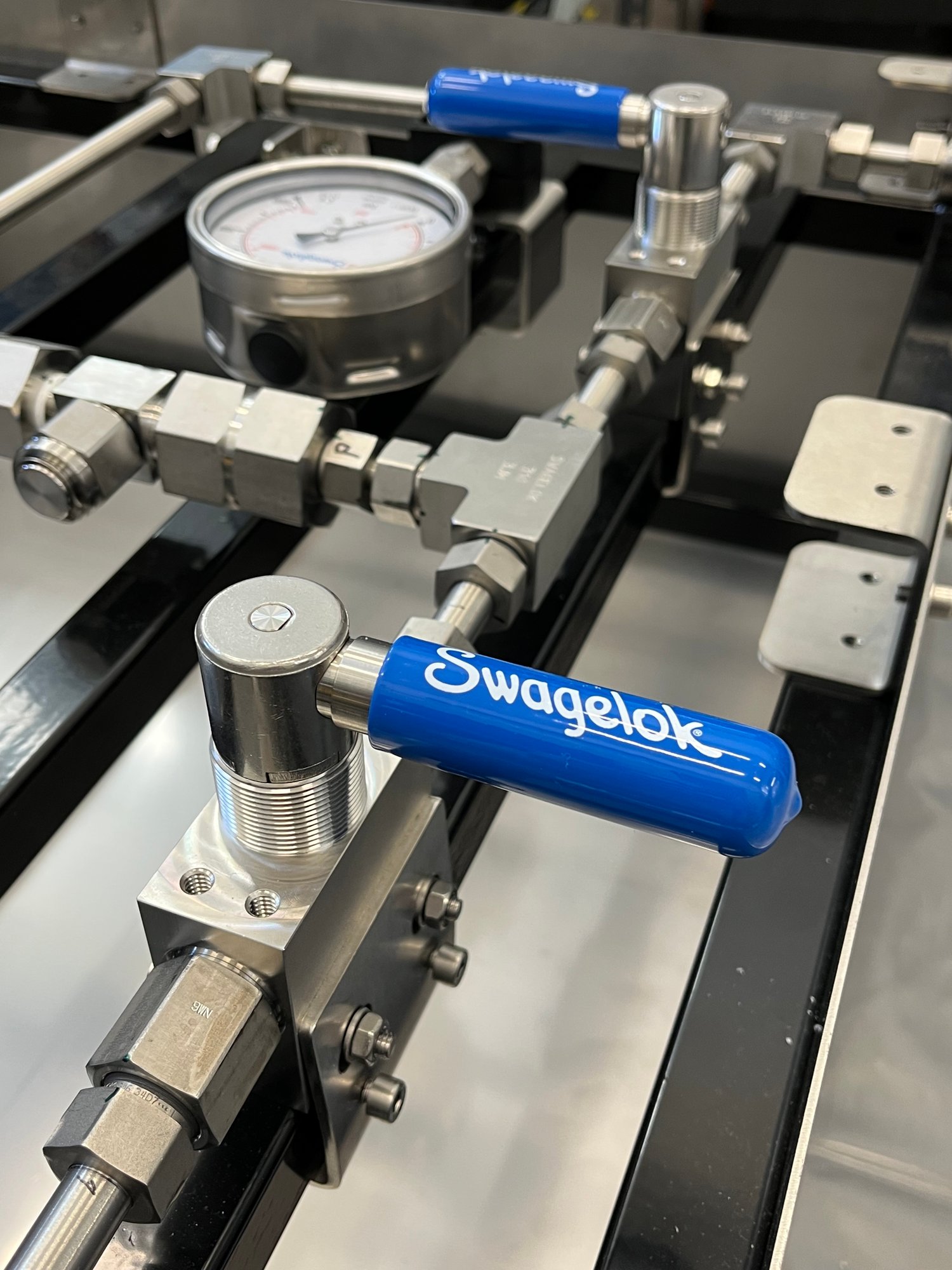
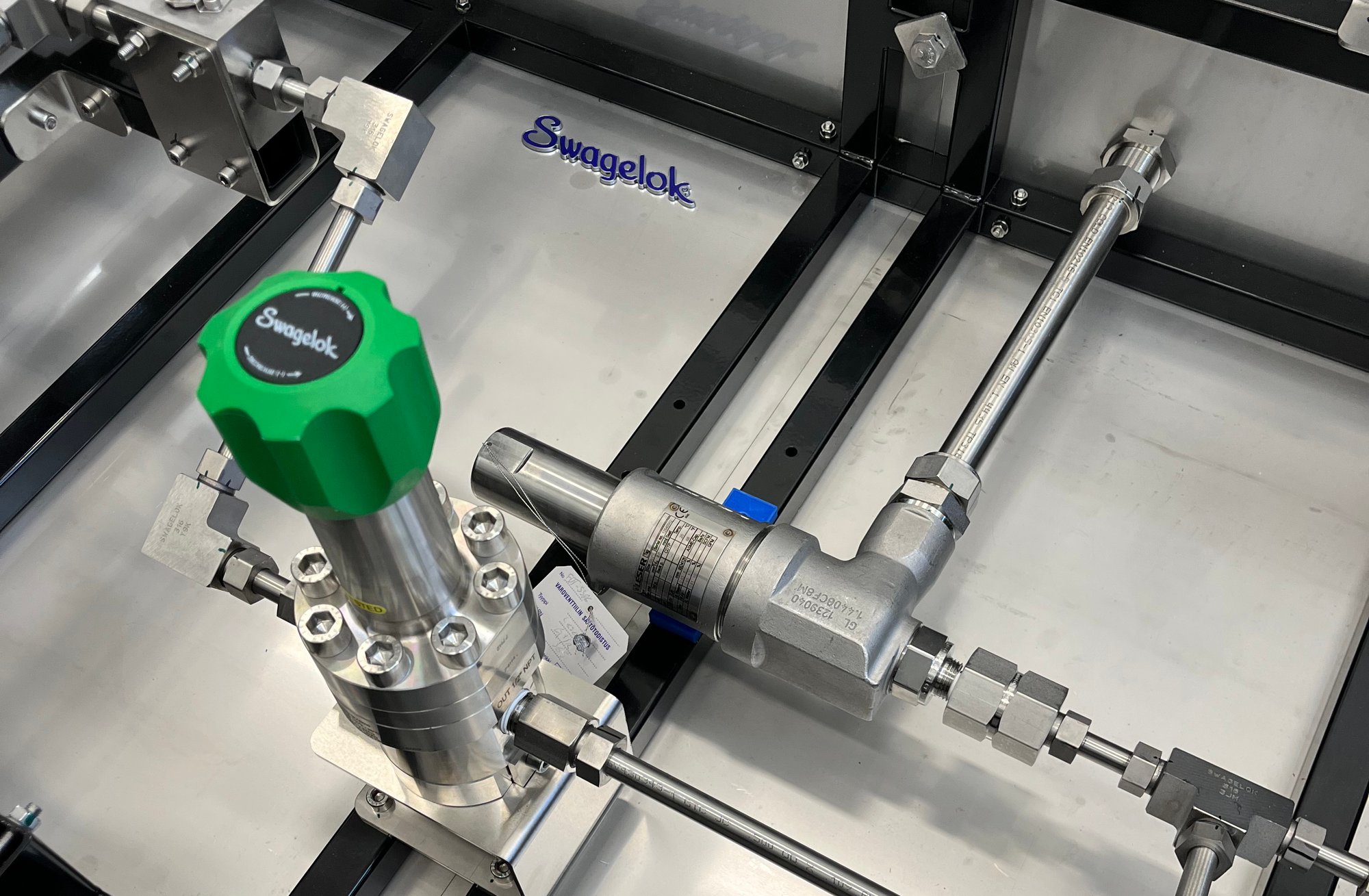
The panel is manually operated. Two pressure gauges allow the operator to monitor the inlet and refuelling pressures, while a hand-operated valve is used to adjust the flow. HyAero Dynamics provides instruction for operators before use.
The design includes two vent lines serving different parts of the assembly. These provide means to depressurise the relevant sections when the supply is isolated, including relieving pressure in the refuelling connection before disconnection. A pressure relief device provides an additional protective function.
Before delivery, the assembly underwent helium leak testing at 69 bar at Swagelok Helsinki. A further test with nitrogen at 300 bar was carried out before its first use with hydrogen.
For HyAero Dynamics, the ability to obtain an assembled and tested panel was a significant part of the collaboration.
From workshop testing to airport operation
The panel was tested as part of the BSR HyAirport and H2Value projects. The first hydrogen refuelling deployment took place during Tartu Hydrogen Days. Matiss from Swagelok Helsinki attended to support the initial operation.
In October 2026, the panel was being used at Riga International Airport to refuel fuel-cell baggage tractors during the final phase of BSR HyAirport.
This brought the original concept into a working application: hydrogen supply and a movable refuelling assembly available at the site where the equipment was operating. The airport deployment also provided a test platform for further development.
The HyAero Dynamics panel being used to refuel an airport bus.
Next Steps in Developing the Mobile Hydrogen Refuelling Panel
The current panel is the first version. A subsequent version is planned to incorporate a Swagelok RAMP regulator and PID controller to provide more controlled refuelling and reduce the need for manual adjustment.
There is also a need for test usage in multiple other European countries facing similar refuelling constraints. Further panels, rental arrangements and sales are possibilities under discussion.
The team sees potential beyond airports, including cylinder-bundle filling and other locations where existing refuelling equipment does not meet the application’s needs.
For now, the project has produced a working panel and operating experience on which to base the next design decisions. HyAero Dynamics has expressed interest in continuing to work with Swagelok Helsinki on assembly, testing, and documentation as the concept develops.
Read more about how Swagelok Helsinki can support developing hydrogen industry
Our solutions and expert services
Discover our ready-made solutions and supporting expert services.
Gas and Liquid System Condition Assessment and Risk Management
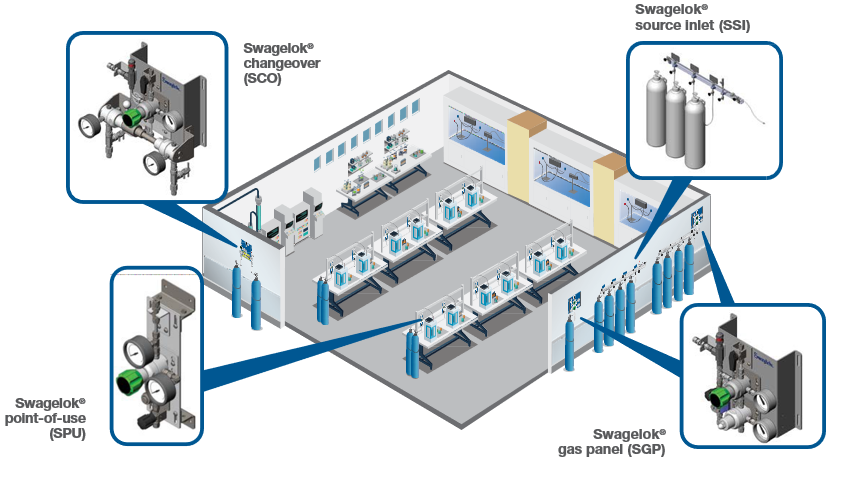
Customizable Swagelok Gas Distribution Solutions and Systems
Closed Sampling System Enhances Safety in Ammonia Handling
We provide assembly services and orbital welding in a cleanroom environment
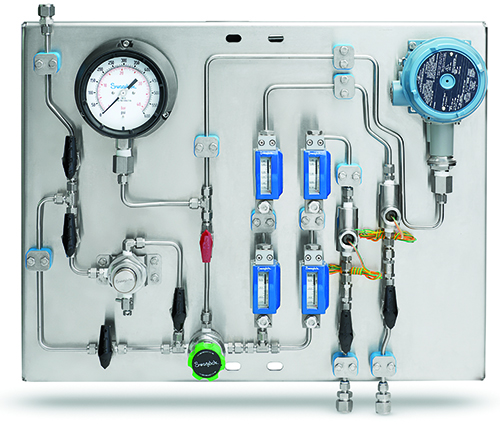
Mechanical Seal Support Systems in Compliance with API Plan Standards