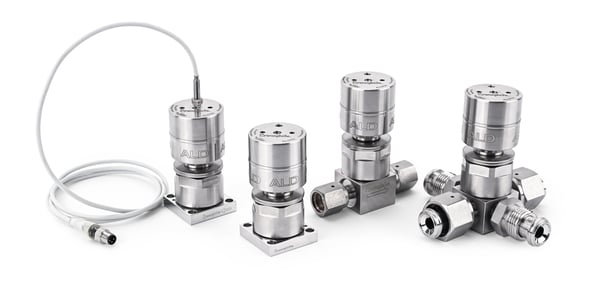


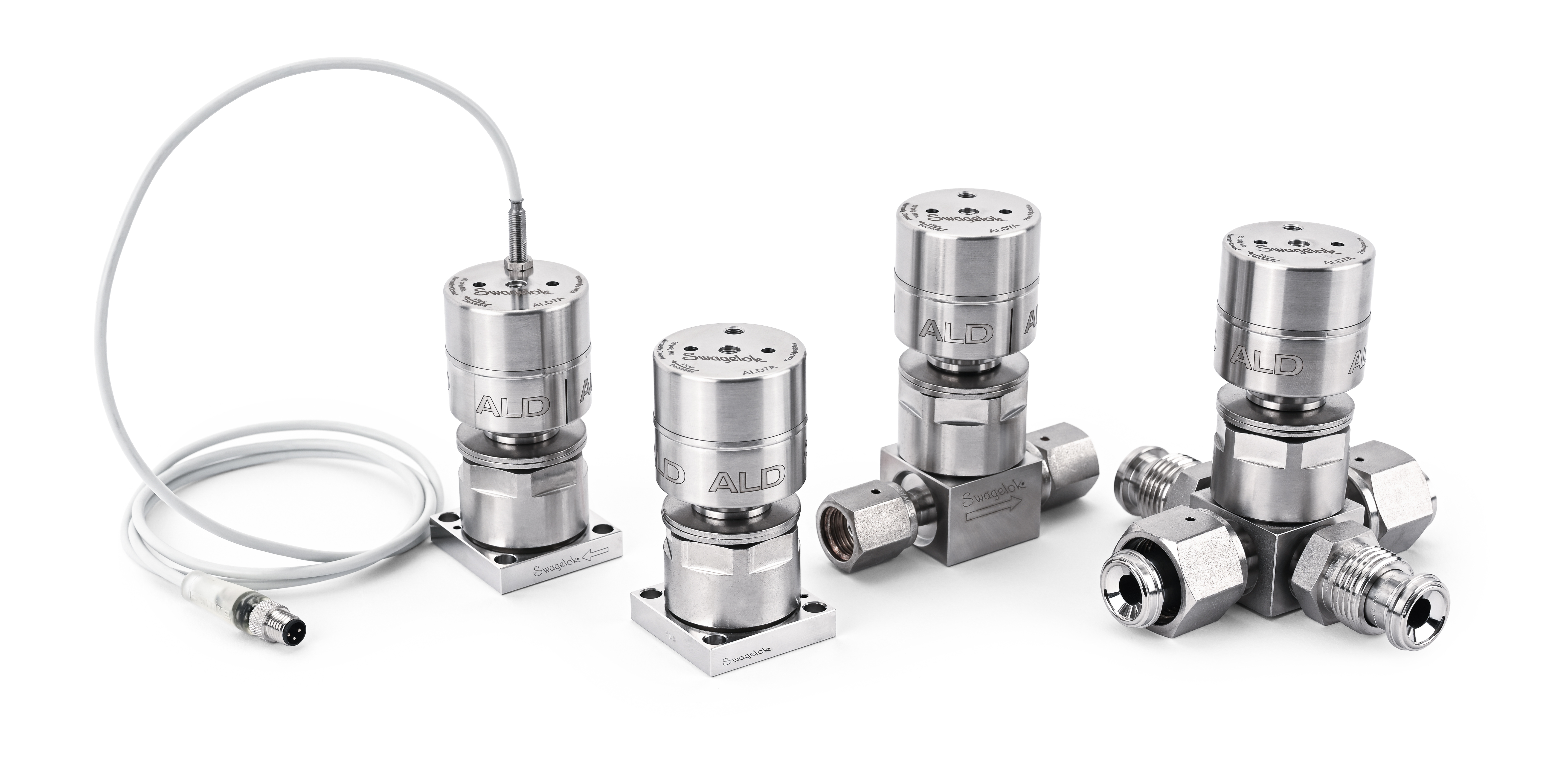
In the evolving ALD and ALE processes of the semiconductor industry, valves are required to provide ever-greater precision and repeatability in dosing and pulsing, fast operation, and durability at high temperatures and under demanding chemical conditions.
The Swagelok® ALD7C diaphragm valve meets these requirements by combining Alloy 22 material, full-immersion capability up to 250 °C, open-to-close and close-to-open times of less than 2 ms, and factory-calibrated flow accuracy of ±1%.
The ALD7C is suitable for processes that use low vapor pressure ALD precursors. These precursors require high supply temperatures to remain in the vapor phase and may contain highly corrosive chemicals.
What features of the ALD7C support precise dosing and pulsing?
- The Alloy 22 construction for superior corrosion resistance and low particle generation from contact with aggressive precursor chemistries.
- Full-immersion capability up to 250°C enables the high delivery temperatures required by low vapor pressure precursors.
- A flow coefficient of 0.7 Cv maintains good flow capacity even at high temperatures and under demanding vacuum conditions.
- An opening and closing speed of less than 2 ms enables precise dosing with short pulse durations.
- Factory-calibrated flow with ±1% accuracy improves dosing consistency across valves, chambers, and tool-to-tool consistency.
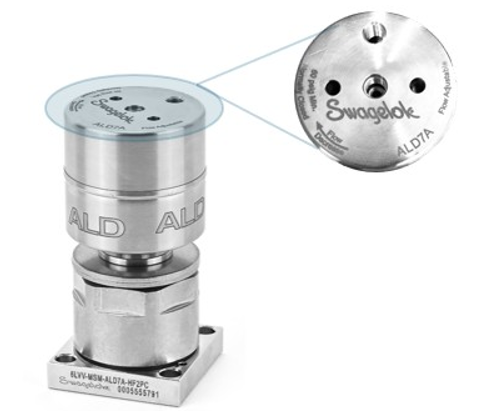
- Field-adjustable flow allows the Cv value to be reduced by up to 35% from the factory setting.
- Long service life, flow conductance and valve-to-valve consistency ensure repeatable dosing over millions of cycles.
How does flow conductance and valve-to-valve consistency support the ALD process?
The valve’s consistent flow behavior enables greater flow conductance under vacuum conditions. As a result, flow capacity remains high even at temperatures exceeding 150 °C and pressures below 100 Torr.
The result is faster and more precise precursor dosing into the process chamber, faster pulse and purge cycles, improved dosing repeatability, better chamber-to-chamber uniformity, and reduced sensitivity to pressure drops in the gas distribution system.
How does the serviceable design of the ALD7C reduce downtime?
The ALD7C’s modular cartridge design allows the diaphragm and seat to be replaced without having to replace the entire valve body. A single valve body can be serviced up to five times by replacing the cartridge with a new one.
Maintenance can be performed directly on the production equipment, which can reduce maintenance downtime and the valve’s lifecycle costs. Separate actuator kits are also available to facilitate maintenance.
In what configurations is the ALD7C available?
The ALD7C is available as a single valve and integrated into custom, additively manufactured (AM) Alloy 22 manifolds. The integrated solution allows multiple ALD7C valves to be combined into a compact unit, which reduces the number of connection points, minimizes the risk of leaks, and facilitates the implementation of application-specific UHP flow solutions.
What are the technical specifications of the ALD7C?
|
Feature |
Value |
|
Operating pressure |
Vacuum – 4.2 bar |
|
Burst pressure |
>220 bar |
|
Actuator pressure |
4.8–6.9 bar |
|
Operating temperature |
10–250 °C |
|
Flow coefficient |
0.7 Cv, factory setting |
|
Body material |
Alloy 22 |
|
Diaphragm material |
Alloy 22 |
|
Seat material |
PFA |
|
Opening/closing times |
<2 ms |
|
End connections |
VCR®, H-type VCR fittings, and tube weld end connections |
Features of the ALD7C Series Compared to Other ALD Series
A check markindicatesthe feature or rating listed in the table.
|
Feature |
ALD3 |
ALD3T |
ALD6 |
ALD6T |
ALD7A |
ALD7C |
ALD20 |
|
Flow coefficient (Cv) |
0.3 |
0.3 |
0.6 |
0.6 |
0.7 |
0.7 |
1.7 |
|
Field flow adjustability |
|
|
|
|
✓ |
✓ |
|
|
Replaceable cartridge design |
|
|
|
|
|
✓ |
|
|
Normally open |
✓ |
✓ |
✓ |
✓ |
|
|
|
|
Normally closed |
✓ |
✓ |
✓ |
✓ |
✓ |
✓ |
✓ |
|
1.4 bar (20 psig) |
|
|
|
|
|
|
✓ |
|
4.1bar (60 psig) |
|
|
|
|
|
✓ |
|
|
10.0bar (145 psig) |
✓ |
✓ |
✓ |
✓ |
✓ |
|
|
|
Max. body temperature: 120°C |
✓ |
|
✓ |
|
|
|
|
|
Max. body temperature: 200°C |
|
✓ |
|
✓ |
✓ |
|
|
|
Max. body temperature: 250°C |
|
|
|
|
|
✓ |
✓ |
|
Max. actuator temperature: 120°C |
✓ |
✓ |
✓ |
✓ |
|
|
|
|
Max. actuator temperature: 150°C |
|
|
|
|
✓ |
|
|
|
Max. actuator temperature: 250°C |
|
|
|
|
|
✓ |
✓ |
See more information in the technical reports.
Why is ALD7C suitable for UHP semiconductor processes?
Swagelok ALD7C is the solution for UHP semiconductor processes where precise metering, fast response, high-temperature resistance, and chemical resistance are critical.
Where can I find more information about the ALD7C?
Additional information can be found in Swagelok product catalogs MS-02-301 andMS-02-442, as well as in technical report MS-06-128.
FAQ
What processes is the ALD7C suitable for?
The ALD7C is suitable for demanding ALD and ALE processes, as well as processes that use low vapor pressure ALD precursors.
What is the maximum operating temperature of the ALD7C?
The specified operating temperature range for the ALD7C is 10–250 °C.
How fast does the ALD7C open and close?
The ALD7C’s has ultra-fast actuation, capable of valve opening and closing times of less than 2 ms for precise dose control.
Can the flow rate of the ALD7C be adjusted at the point of use?
Yes. The flow rate can be adjusted in the field, and the Cv value can be reduced by up to 35% from the factory setting without returning the valve to the factory.
Can the ALD7C be serviced without replacing the entire valve body?
Yes. Thanks to its modular design, the diaphragm and seat are replaced as a single cartridge.
Is the ALD7C available as an integrated manifold solution?
Yes. The ALD7C is available as a standalone valve and integrated into additively manufactured Alloy 22 manifolds.
What materials are used in the ALD7C valve?
The valve body and diaphragm are made of Alloy 22. The seat material is PFA.
For more information about ALD7 valves and other products suitable for the semiconductor industry, please contact our experts:
.jpg?width=100&height=100&name=Sebastian-Mandelin%20(2).jpg)
Sebastian Mandelin
Sales Engineer

Tristan Lumme
Field Engineer, Solution Design
Share this article